16 May 2009

THE BRONZE GALLERY OF THE GOVERNEMENT MUSEUM - CHENNAI- EGMORE


The bronze gallery features has the finest collection of almost 700 bronzes from South India, mainly from the PALLAVA & CHOLA period (9th - 13th century). They have been saved and retrieved from temples and sites in the region There are many very expressive and impressive of Nataraja (SHIVA) performing the cosmic dance of creation. Other bronzes show Shiva and Parvati. But also Vishnu, Rama,Ramanraya, Sita and Ganesh are shown in differnt positions with their holistic attributes


STREETDOG'S COMPLAINT- FROM BRINDLE

Brindle
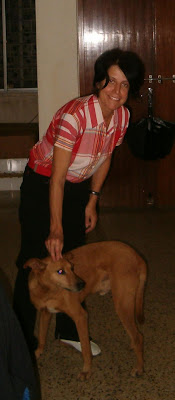
Woof! I’m Brindle, the street dog who adopted Bunnylady and Jugfellow some years ago. The reason i’m writing this is because Jugfellow is too upset to write his column himself. Why? Because, once again, some misguided residents of the National Media Centre, the cooperative housing society near Gurgaon where we live, have started off on the so-called ‘stray dog menace’. This happens with unfailing regularity, not just in the NMC but also in that macrocosm of the NMC that we call India. From Kochi to Kolkata, Bagdogra to Bangalore, someone or the other will bring up the stray dog menace, causing a whole lot of innocent, perfectly harmless street dogs to be rounded up and, more often than not, put to death in the most inhumane and cruel manner.
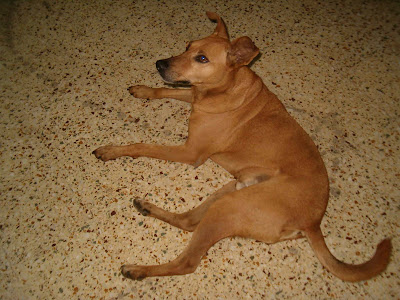
People never seem to understand that the Indian street dog (please don’t call us strays) are hardy, intelligent, affectionate creatures, often much more so that their pedigreed, imported counterparts, who have been viciously inbred by exploitative breeders. Street dogs have to be all these things in order to survive. Far from harming people, they are – when properly vaccinated against rabies and other diseases – man’s best pals, to coin a phrase. They act as excellent guards for the neighbourhood, alerting everyone to the intrusion of strangers by barking. Yet people keep on wanting to get rid of them. Not realising that nature abhors a vacuum and if you get rid of one lot of street dogs, another lot will inevitably take their place.
There is no such thing as a ‘stray dog menace’. There is only a ‘stray human menace’. Who is it that has strayed from the straight and narrow of God’s plan (and please don’t tell me that God is dog spelt backwards, because if i’ve heard that once i’ve heard it for the umpteenth time)?
Is it dogs, who live together amicably in the casteless, creedless democracy of doggydom, who have strayed? Or is it humans, with their caste conflicts and their religious wars, their whites and their blacks, their Hindus and Muslims and Sikhs and Christians, their Maoists and their monarchists, their Indias and their Pakistans, their terrorists and their victims, who are the real strays? And the real menace. Not only to each other, but to all of the rest of creation as well.
It wasn’t dogs who created 9/11, and 26/11, and al-Qaeda, and the Sri Lankan civil war, and the Taliban, and not one but two world wars. All these are human creations. And what wondrous creations. Can you imagine a dog creative enough to devise 65,000 nuclear warheads capable of killing every living creature on this planet a hundred times over? No. Only humans are creative enough to have done that. Though they have yet to prove themselves creative and clever enough to find a cure for the common cold. Or AIDS, or cancer, or a score of other killer diseases.
Humans have been too busy doing other things. Like polluting the planet and destroying its environment. The world’s forest cover has been thinned from 7.6 billion hectares in the pre-industrial age to 2.8 billion hectares. And that’s fast disappearing. Between 1700 and 1900, thanks to human activity, more than 20,000 species of plants, 593 species of birds, over 400 species of animals and 209 species of amphibians became extinct. Today, humans wipe out one species every day on an average. Tell me about the ‘stray dog menace’.
Unlike humans, who think the universe and everything in it was created only for their benefit to do with as they will, we dogs believe in the co-fraternity of all living things. And that includes cats. Cats? Oh, lor, what have Bunnylady and Jugfellow done? They’ve let Himal into the place. And Himal is a cat! Who insists on literally rubbing shoulders with me. Yuck. So, while there’s no such thing as a stray dog menace, if you were to talk about a stray cat menace, you might get me to agree. Or maybe not. For the basic dharma that doggydom teaches is to live and let live. Which means cats too. Where’s that damn Himal gone to…?

Web Linkshttp://blogs.timesofindia.indiatimes.com/jugglebandhi/
Contactsjug.suraiya@timesgroup.com

Printed without the permission of Jug Surai... I admire a lot and would like to recommend his books like JUGGLING ACT as compensation

11 May 2009

CATOLIC CHENNAI


According to the legend Sant Thomas ( the doubting Thomas), came to South India via Cranganore in AD 52 and spent the next 12 years along the Malabar coast converting the local population. He gradually moved eastwards and finaly settled in Mylapore (is nowadays the old city-centre of Chennai. He spent the last years of his live in a cave on a small hill (on top is nowadays a chappel)from which he would walk each day to the beach. It is said that one day preaching on the Mount of Saint Thomas , he was killed by means of a lance. His body was brought to San Thome, where he was burried in nthe small crypt he had build. This is today the Basilica of San Thome (see pictures). The Portuguese colonized Mylapore in the early 16 the century , lured by the 13 the century Venetian traveller Marco Polo who had visited the earlier Nestorian chapel.The saint holds a special place in the hearts of the Indians and was decreed the Apostle of India in 1972


10 May 2009

INDIAN SLEEPING ATTIDUTES & SOME GENERAL CONCERNS

Most homes in India have cots or beds but a sizable proportion do not have a mattress, as the khatiya (rope cot = just the frame of a bed and some belts in between.
According to the recently released INDICUS CONSUMER HANDBOOK a majority of Indians sleep on the floor as the average home area is small ND THERE IS NOT MUCH SPACE FOR ADDITIONAL FURNITURE. Consequently the beds are put for alternative uses, sometimes just used as sofas sometimes as communication centre at family assemblies.

Data collected from various governmental surveys shows that
 86 % of Indian homes have cots or beds
 75 % of the urban homes have a mattress to sleep on.

Contractor to the projected boom, most homes at the country side have no telephone connection and only 36 % of urban homes posses a mobile phone.

And despite the entry of the NANO, the humble bicycle still continiu to be the preferred mode of transportation. ONLY 3 % of Indians have a car!!!

But all this is not a problem at all since Indians are sexualy very active and fertile it is their goal to populate the overall world with small Indians ... London is already taken, the others will come soon. And don't forget once Indian in the next 10 generations you will find merits in the Indian newspapers even if in the mean time you are indian- irish- scottish- polish spanian.... India will welcome you as a king as soon as you might have been able to hit a ball in public, thrown by some proffesional ball thrower ( they call it cricket)

INDIA AT HIS BEST- SODEMIAN LAWS AND GAY MARRIAGES


Based on Mansi Choksi | TNN Article in TIMES OF INDIA of today ( without permission, I deeply regret)


Last week, Durban-based sales advisor Joe Singh and his partner Wesley Nolan solemnized their relationship at a ceremony by an Hindu priest. In the Singh living room, Wesley tied a necklace with a Ganesha pendant around Joe’s neck. The couple, now honeymooning in Mauritius, chose the Ganesha instead of garlands because both of them are “staunch Hindus’’ and wanted the Elephant God to “ward off evil and remove obstacles from their path’’.
The grooms had sent out shimmering wedding invitations weeks in advance, had hand-embroidered shervanis shipped all the way from India, and took their vows before a havan or sacred fire. They spent 18 months preparing for their big day and Joe’s mother Rita Govender said the family had been extraordinarily supportive.

A year ago, a Mumbai based IT professional married his white boyfriend of five years in a boisterous ceremony in Seattle. They too had the shervanis and havan. Roughly 450 people attended, many of them uncles and aunts from Mumbai. The boy’s parents initially had reservations about making their son’s sexuality public. “But by the end of it, his mother was in mother-in-law mode,’’ says one of the guests.

These happy stories may sound unbelievable given the many accounts of social hostility to gay people. But the fact is that same-sex marriage ceremonies have been performed in Indian households, rich and poor, and in cities and small towns alike. The nuptials may not have legal validity but the ritual is remarkable in a country where homosexuality is still considered a criminal act and punishable by up to 10 years in the clink. Ironically, the police cannot bust a same sex marriage because a ceremony cannot prove homosexuality as defined by Section 377 of the IPC.
An activist from Gay Bombay confirms that there are reports of unions every week, be they a lesbian couple in Punjab or Kerala or gay men in Gujarat or Delhi. Ashok Row Kavi, who opened the closet in India, says he knows several gay couples who tied the knot. “There’s one big plus-point about Hindu priests,’’ says Kavi with a straight face. “They’ll forget about everything if you show them a few bucks.’’

While the ‘havan’ nuptials may not have legal standing, the ritual is remarkable in a country where homosexuality is still considered a criminal act punishable by up to 10 years’ in the clink. Ironically, the police cannot bust a same-sex marriage because a ceremony cannot prove homosexuality as defined by Section 377.

Legal status
Homosexual relations are legally still a crime in India under an old British era statute dating from 1860 called Section 377 of the Indian Penal Code which criminalises 'carnal intercourse against the order of nature.' The vague nature of the legislation has resulted in it being used against a wide range sexual behaviour like oral sex (heterosexual and homosexual), sodomy, bestiality, etc. The punishment ranges from ten years to lifelong imprisonment.
The relevant section reads:
Whoever voluntarily has carnal intercourse against the order of nature with any man, woman or animal, shall be punished with imprisonment for life, or with imprisonment of either description for a term which may extend to ten years, and shall also be liable to fine.[32]


None of the major Indian political parties have endorsed gay rights concerns into their official party manifesto or platform.


A Mumbai activist from Gay Bombay confirms that there are reports of marriages every week, whether it is a lesbian couple in Punjab or Kerala or gay men in Gujarat or Delhi. Ashok Row Kavi, who pioneered the opening of the closet in India, says he knows several couples who have tied the knot. “There’s one big plus-point about Hindu priests,” says Kavi with a straight face. “They’ll forget about everything if you show them a few bucks.”

The marriage can be solemnized but the sodomanian act as to be proved, the bestialities maybe obvious but no police man is able to observe.

Same-sex marriage ceremonies are not an entirely new phenomenon, although they’ve largely stayed under the radar.
Arvind and Ashok were married in an Indian ceremony complete with ‘dhotis’ and ‘agni’. “Ashok and I are very sentimental people; we thought it was a great idea,” he says. It was Arvind’s mother, who had once rejected his sexuality, who came up with the idea. “When my family realised that what I had with Ashok was not ‘timepass’, they accepted us. He is very special to my family.”
Activists say that the same-sex marriage movement has emerged independent of the other issues in the gay rights movement. Most gay activists in India weren’t really pushing for marriage because they believed that homophobia and HIV were more pressing battles. Ashok Row Kavi is one of the more vociferous opponents of marriage, which he calls an “oppressive heterosexual institution”. Yet, say activists, it’s a need that can’t be wished away. “It’s the number one question we get from guys in the gay community: How can I find a man to marry?” says a Gay Bombay activist.

05 May 2009

ANGER CAUSES STRESS


By recognizing that we are responsible for our own anger and the stress resulting due to it, we can decide to let it go. This can be done when we are inwardly calm, says Brahma Kumaris

One of the key causes of stress is anger which gets built up inside us in our day-today interactions with certain individuals and from real life situations. The inculcation of the innate virtues of the soul — compassion, forgiveness and tolerance — not only in our words and actions but also at the level of our thoughts, helps us relax.

Breathing exercise for stress management

Sit comfortably upright in your chair. Make sure you are in a position to breathe easily
Allow your breathing to slow down… gently out… and in… with your own natural rhythm
Think of a situation when you were angry with another person and follow these words. Pause for 1 complete breath after each step
As I breathe out I release my anger… as I breathe in I fill myself with compassion…
As I breathe out I let go of resentment… as I breathe in I fill myself with tolerance…
As I breathe out I release feelings of revenge… as I breathe in I gain understanding…
As I breathe out I let go of all worries… as I breathe in I experience peace…
See the other person and send good wishes and feelings of compassion to him/her… to the situation… to all involved (pause for 10 seconds)
Breathe easily. Be calm… at peace… Experience the qualities of forgiveness and tolerance

Benefits

The key to dealing with anger is that we acknowledge that it is our anger and not caused by someone else. When we are angry we blame something or someone. Yet we are the ones experiencing anger; we have the choice to change how we feel and respond. By recognizing that we are responsible for our own anger and the stress resulting due to it, we can decide to let it go. This can be done when we are inwardly calm and reflect on the anger. The above breathing practice helps us in this process.


http://www.bkwsu.org/

03 May 2009

THE WHITE BABA'S


In her long journey from Amarkantak in Madhya Pradesh to the Gulf of Cambay, the Narmada traverses 1,312 kilometres dotted with temples. Like the Ganga, this ancient river has thousands of devotees, many of them from far-off lands. They are the ‘gora babas’ or white sadhus who lead the ascetic life — of meditation, a frugal diet and the occasional chillum. None of them came to India to become ascetics. So what happened? A shrug, a smile and two words explain it all: “My guru.” Many of them have applied for Indian citizenship. As their applications remain caught in red tape, they wait — for that piece of paper. And for salvation.

Narmada Shankar, 44
Originally from Austria
Clad in an ochre loincloth, his matted hair coiled high, Narmada Shankar greets us with an Om Namoh Shivai. He lives in a one-room dwelling, surrounded by the many fruit-bearing trees he has planted. His chelas or disciples run errands for him and help cook his meals. Exactly what he did some 20 years ago for his guru, Brahmachari Raghunathji Maharaj.
Stockl Erwin was training to be a priest in Austria when he set out on a journey to find an answer to the eternal mystery — death. Travelling across Greece, he changed course and landed up in Omkareshwar, where he met his guru. His parents tried to take him back to Austria but failed. And made their peace with him when, on a trip to India, his father found Narmada Shankar giving first aid to poor villagers at the ashram. “My father was so happy. He said, ‘Eighteen years ago, I told your mother our son was a loser, I can now tell her he is a hero’.”

In 1993, Narmada Shankar undertook the Narmada Parikrama, circumnavigating the river on foot without once crossing it. “It
took me three years. I would start at sunrise and stop at sunset, carrying my
meagre belongings on my head and eating whatever I was given in ashrams and homes on the way,” he recalls. His one wish is “to die on the banks of the Narmada”.

Omkarpuri Baba, 52
Originally from France
At the Juna Akhada in Omkareshwar, sitting in vajrasana pose, Omkarpuri Baba recalls how he came to India 22 years ago, went to the Kumbh Mela in January 1989, met his guru, Srimahant Kalyanpuri Baba, and stayed on to be his disciple for life. “So much love. Guruji ne bahut prem diya — apne bachhe jaisa (he gave me as much love as he would his own child),” he says, taking a drag of the chillum. Like the other disciples, he swept and cooked for his guru until his death. “Aur namoh narayan bas (And prayer; that’s all),” he adds.

He refuses to tell us his real name, but does say he worked in the Navy and was an only child. “Forget about the foreigners who have made this land their home. Write about the way this land is going to be destroyed in the next two decades,” he instructs me, pointing to the overflowing gutter snaking its way into the river and a heap of discarded plastic and other waste.

Pujari Ram Das, 53
Originally from Italy
Ram Das, born Oscar Spill in the harbour city of Ancona in Italy, came to India in 1975 as part of a team to research India’s holy men. The team split over whether to go north or south. Spill decided to go his own way, found his guru, Raghuvir Dasji, on the banks of the Narmada and stayed with him for 20 years. “After he passed away I roamed the country till I reached Janki ghat in Varanasi and learnt the puja rituals from priest Ram Palak Das. I then served as the pujari in a temple in Ayodhya before the trustees of the Hanuman temple asked me to come to Indore,” he says.

Pujari Ram Das wakes up at 3.30 am and meditates for an hour before cleaning the temple, bathing and dressing the deity, and preparing the prasad for the gods. Does he occasionally offer a prasad of pasta? The lines around his eyes deepen as he laughs, “No, only Indian fare.”

02 May 2009

THE WEATHER FORECAST FOR DELHI FOR the 2 MAY

TURMERIC (CURCUMA, GELBWUERZ) FOR HEALTH


Health benefits of turmeric

With its ability to purify blood and protect body, this wonder spice can be used to cure or alleviate a number of ailments


Known to Indian and Chinese civilizations for 5000 years, turmeric or haldi adds colour, flavour, purity, and health to life. Revered as the golden goddess, this wonder spice is used in food, religion, cosmetics, medicine and Ayurveda. As tilak or kumkumapplied to gods, as a dye for holy robes and a component of any puja or wedding, it is considered a “purifier” and a protector.


Benefits of haldi:

Haldi contains curcuminoids (plant-based powerful anti-oxidant and anti-inflammatory nutrients counteracting the effects of free radicals) that relieve arthritis pain and stiffness; inhibit cancer initiation, promotion and invasion and prevent and help treat Alzheimer’s and depression
Its volatile oils accelerate wound healing, fight infections and allergies, boost immunity and alleviate asthma
It prevents cholesterol oxidation and its high levels of vitamin B6 protect the heart
It strengthens and improves digestion, thereby reducing gas and bloating. Promotes healthy metabolism and weight management
It supports healthy liver function and detoxification by increasing bile flow and rejuvenating the liver cells


The rhizome (root) of turmeric has long been used in traditional Asian medicine to treat gastrointestinal upset, arthritic pain. Turmeric has long been used as an anti-inflammatory, to treat digestive disorders, osteoarthritis, atherosclerosis, cancer and liver problems and for the treatment of skin diseases and wound healing. It is believed to strengthen the overall energy of the body, relieve gas, dispel worms, regulate menstruation, dissolve gallstones, and relieve arthritis. The active components of turmeric reduce the destructive activity of parasites or roundworms. It has also demonstrated in animals a protective effect on the liver, anti-tumor action and ability to reduce inflammation and fight certain infections.


Curcumin 95%, a potent antioxidant is believed to be the most bioactive and soothing portion of the herb turmeric. Curcumin 95% posses the properties like antioxidant, anti-inflammatory, anti-platelet, cholesterol-lowering antibacterial and anti-fungal effects. It contains a mixture of powerful antioxidant phytonutrients known as Curcuminoids. Curcumin 95% inhibits cancer at initiation, promotion and progression stages of tumor development. It is a strong anti-oxidant, which supports colon health, exerts neuroprotective activity and helps maintain a healthy cardiovascular system. It is used as coloring matter in pharmacy, confectionery, cosmetic and food industries. It is also used as a key ingredient in some cosmetic products like cream, soaps and cleansers.


Purifies the blood Using it as a protective shield:

Use a pinch of turmeric as a spice in cooking For better digestion, eat a mixture of 1 tsp of turmeric in 1 cup of yoghurt right after lunch For relief from asthma, allergies, muscle aches and pains, and for anti-ageing and anti-inflammatory effects,
boil 1 cup of milk with 1 tsp of turmeric powder and drink it before going to sleep For a beautiful complexion, and for getting rid of unwanted facial hair, apply a paste of turmeric and honey on the skin before going to bed and wash off after 5 minutes For detoxification of the blood and liver, take 1 tsp of raw turmeric rhizome juice mixed with honey everyday

DELHI & GURGAON WITHOUT POWER

For an Indian it is normal that each day there is one or more power cuts, they can take less than a minute are take half a day. Indian just get fuming if the power- cuts comes unexpected and with a high frequency. The minimum of the expectations is that the government at least announces the power- cuts.
For me it is not understandable why Indians accept this situation. Everybody being proud that money is spoiled on a totally unnecessary mission to the moon and to buy the used air fighters of the Russian and France air force to fight a non- existing enemy (Pakistan) instead of building power plants.

A country gifted by nature with a tremendous solar energy, is since ever fighting against this free power instead of collecting and use it. Just because in the WEST (where there is a lack of sun energy) they fight the heat with air - conditioners.

With the mercury rising to 44 C angry Delhiites said they felt they were back a decade ago, facing six hours of power cuts daily. The peak demand on Friday touched 3,800 MW and according to the state government, there was a shortage of almost 400 MW power in the city which led to widespread power cuts.


Fed up with excuses, many Delhiites questioned why the government could not provide a load shedding schedule so they could be prepared in advance. It can happen anytime from afternoon to night and is very inconvenient for us. Last night, the power went off for two hours and even the power provider helpline was useless. We went to the local BSES office at 1 am and then only supply resumed,’’ said an irate resident of Lajpat Nagar.

Power provider BSES — which services most of Delhi — claimed that it was not possible to have a load shedding schedule because it was not possible to predict when there would be low frequency in the grid and when load would peak. They further set only a set pattern could make a load shedding schedule possible. ‘‘There is no shortage of power in Delhi. We have tied up for more than sufficient power but it is unable to reach us. If there is a power shortage, we will give a load shedding schedule,’’ said a top BSES official.

So it is just all happening in my dream that I am in the dark and I loose all the time the connection to my WLAN because of a non- existing power cut.

FEEDJIT Live Traffic Feed